
Twelve months of Google Search Console data reveal a striking contradiction: a 66.74% CTR on branded searches — genuine name recognition — paired with zero search visibility for five of SBN’s seven target communities. The content was reaching nature enthusiasts and environmental professionals. It wasn’t reaching the at-promise youth, BIPOC families, and multilingual communities the organization exists to serve.
Overview
Brand authority
Critical
Missed opportunities
Critical
Target community invisibility
Mobile-dominant engagement
Local market success
Table of Contents
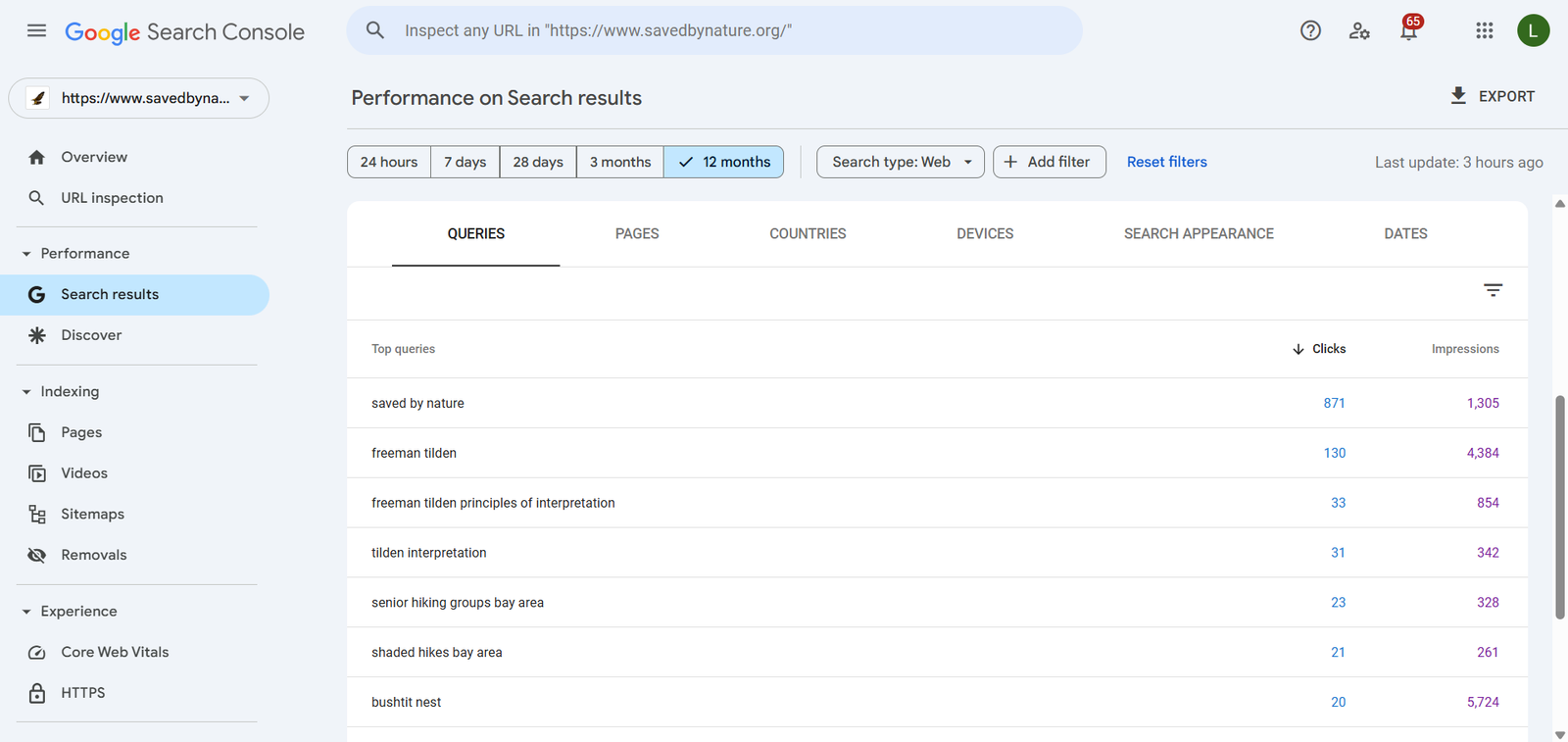
The top two traffic drivers were a branded query and a Freeman Tilden blog post. The most mission-relevant query in the top seven — “senior hiking groups bay area” — drove just 23 clicks over 12 months. Notably, “bushtit nest” generated 5,724 impressions but only 20 clicks, exposing a significant mismatch between the content SBN was ranking for and the communities it was built to serve.
| Search Query | Clicks | Impressions | CTR | Avg. Position | Performance Classification |
|---|---|---|---|---|---|
| "saved by nature" | 871 | 1,305 | 66.74% | 1.01 | 🟢 Exceptional brand performance |
| "freeman tilden" | 130 | 4,384 | 3% | 5.6 | 🟢 Educational authority established |
| "freeman tilden principles of interpretation" | 33 | 854 | 4.13% | 6.71 | 🟢 Professional content success |
| "tilden interpretation" | 31 | 342 | 9.55% | 4.52 | 🟢 Strong niche authority |
| "senior hiking groups bay area" | 23 | 328 | 6.97% | 3.48 | 🟡 Target audience connection |
| "shaded hikes bay area" | 21 | 261 | 8.56% | 4.88 | 🟡 Accessibility-focused content |
Freeman Tilden-related queries alone generated 194 monthly clicks across the three related search terms, establishing clear educational authority within the environmental interpretation field. However, this authority was concentrated in a professional and academic audience segment — not in the target communities defined in SBN’s mission.
| Search Query | Impressions | Clicks | CTR | Avg. Position | Gap Assessment |
|---|---|---|---|---|---|
| "bushtit nest" | 5,724 | 20 | 0.35% | 2 | 🔴 Massive audience, minimal engagement |
| "bat fest" | 1,348 | 13 | 0.96% | 11.69 | 🔴 Event interest not captured |
| "shaded trails near me" | 1,259 | 10 | 0.79% | 13.04 | 🔴 Local accessibility searches underperforming |
| "hiking for seniors" | 171 | 2 | 1.17% | 20.94 | 🔴 Target demographic not reached |
The “bushtit nest” data point is particularly instructive. The page was ranking second in Google — the content had earned strong authority — but the title and meta description were not compelling enough to generate clicks from an audience that had already demonstrated search intent with 5,724 monthly impressions. This was a title/meta description optimization problem, not a content quality problem.
Freeman Tilden-related content consistently ranked in top-10 positions. The blog post alone drove 903 clicks per month. The professional development and environmental education audience was being reached effectively. This represented the strongest organic traffic signal in the dataset — a clear content category that was working.
Wildlife content was achieving strong rankings (positions 1–3 in several cases) while generating extremely poor click-through rates (0.35–1.17%). The gap between ranking position and CTR pointed directly to title and meta description optimization gaps — not algorithmic or content issues, but on-page metadata that wasn’t matching the intent of searchers finding the content.
Strong presence — 903 clicks from the Freeman Tilden blog post alone.
Limited but present — 23 clicks from “senior hiking groups bay area”.
Completely invisible — no youth intervention or alternative program searches ranking.
Completely invisible — no cultural or diversity outdoor programming searches.
Completely invisible — no accessibility searches ranking.
Completely invisible — no Spanish or multilingual search visibility.
Completely invisible — no nature therapy or healing searches ranking.
Five of SBN’s seven defined target communities generated zero search visibility. The two with any presence — environmental professionals and senior citizens — were the most incidentally served by existing content, not the communities at the center of SBN’s mission statement.
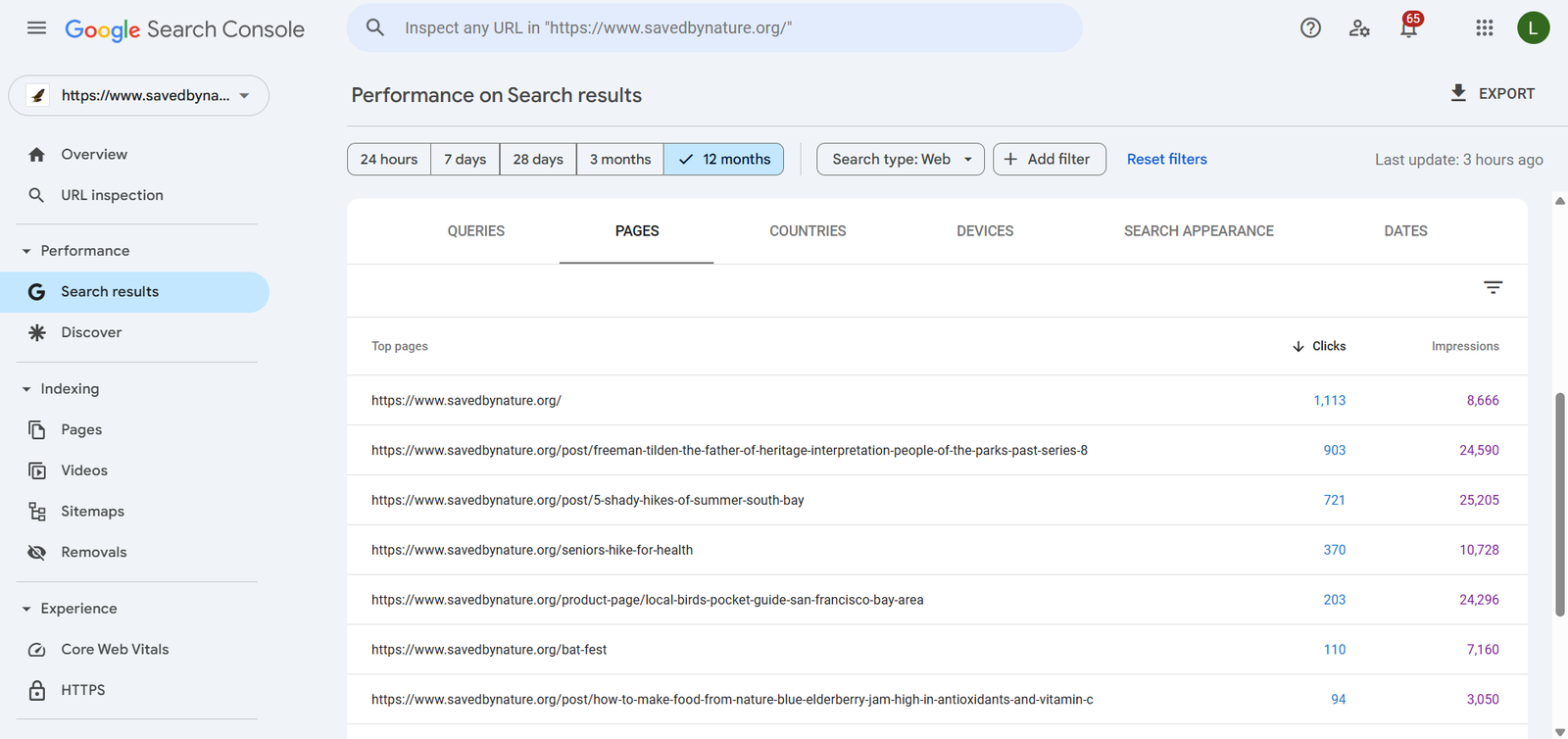
Two blog posts — Freeman Tilden (903 clicks) and 5 Shady Hikes (721 clicks) — were driving more traffic than any program page. The Seniors Hike for Health program page was the only mission-relevant page in the top seven, at 370 clicks. The remaining high-traffic pages were blog posts and a product listing with no direct connection to program enrollment.
| Page | Clicks | Impressions | CTR | Content Type | Mission Alignment |
|---|---|---|---|---|---|
| Homepage | 1,113 | 8,666 | 12.83% | General entry point | 🟡 Broad audience appeal |
| Freeman Tilden Heritage Interpretation (Blog Post) | 903 | 24,590 | 3.72% | Educational content | 🟢 Professional authority |
| 5 Shady Hikes of Summer (Blog Post) | 721 | 25,205 | 2.98% | Accessibility-focused content | 🟡 Senior audience potential |
| Seniors Hike for Health (Program Page) | 370 | 10,728 | 3.47% | Target audience program | 🔵 Direct mission alignment |
| Local Birds Pocket Guide (Product Page) | 203 | 24,296 | 0.84% | Commercial/educational product | 🔴 Poor engagement despite visibility |
| Bat Fest 2023 (Event Page) | 110 | 7,160 | 1.59% | Outdated event promotion | 🔴 Low community engagement |
The homepage’s 12.83% CTR indicated strong brand appeal for general searches and functioned as the primary entry point for brand-aware visitors. Its 8,666 monthly impressions reflected broad search presence, but the traffic it attracted was general rather than mission-specific.
The Freeman Tilden blog post was the site’s most impressive organic performer in terms of raw impressions — 24,590 per month, with 903 clicks. It established clear authority in the environmental interpretation field and demonstrated that long-form educational content could generate sustainable organic traffic. The problem was audience alignment: this content was reaching professionals and academics, not the underserved communities in SBN’s mission.
The Seniors Hike for Health program page was the only mission-specific program page generating measurable search traffic — 370 clicks at 3.47% CTR. No other program pages appeared in the top performers. Youth-focused program content was entirely absent from the ranking data.
The Local Birds Pocket Guide product page had 24,296 monthly impressions — the second-highest impression count on the site — but generated only 203 clicks (0.84% CTR). This followed the same pattern as the wildlife content: high ranking visibility, poor title/meta conversion.
Across the full pages dataset, four distinct content type patterns emerged: educational/interpretive content generated high impressions with moderate engagement; accessibility content generated high impressions but poor conversion; event content generated moderate impressions with low engagement; commercial content generated high impressions with very poor engagement — the lowest conversion rates across all content types on the site.
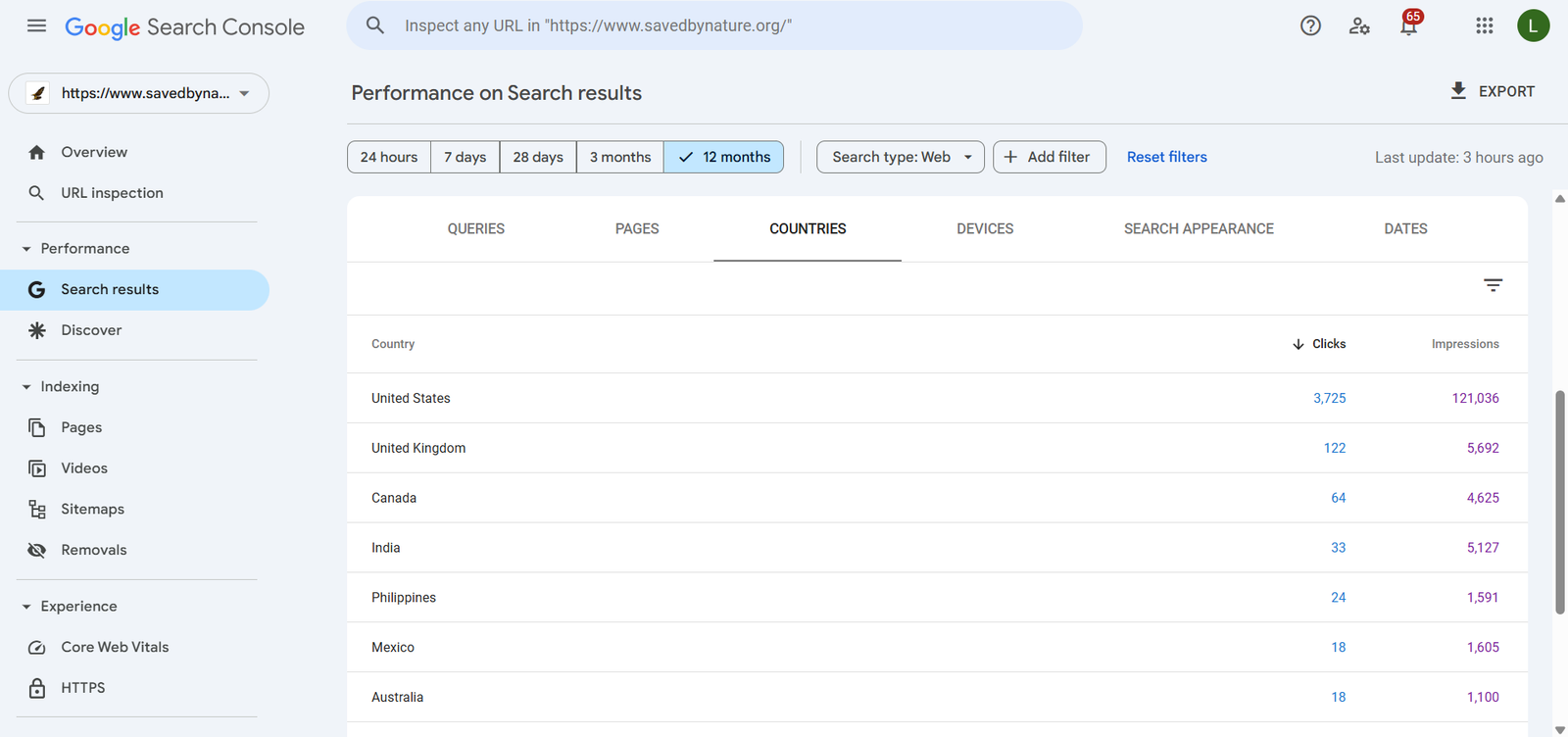
The United States accounted for 3,725 of the 4,350 total clicks, confirming strong domestic relevance. However, the presence of significant impression volume from the UK, Canada, and India — countries with no connection to SBN’s Bay Area programs — pointed to blog content attracting an internationally distributed but largely non-actionable audience.
| Country | Clicks | Impressions | CTR | Traffic Share | Geographic Relevance |
|---|---|---|---|---|---|
| USA | 3,725 | 121,036 | 3.09% | 85.6% | 🔵 Primary service area |
| UK | 122 | 5,692 | 2.14% | 2.8% | 🔴 Cannot participate in programs |
| Canada | 64 | 4,625 | 1.38% | 1.5% | 🔴 Cannot participate in programs |
| India | 33 | 5,127 | 0.64% | 0.8% | 🔴 Cannot participate in programs |
| Philipines | 24 | 1,591 | 1.51% | 0.6% | 🔴 Cannot participate in programs |
85.6% of all traffic originated from the United States, confirming that geographic targeting was working. The 3.09% CTR from US traffic indicated strong domestic relevance. Bay Area concentration within the US audience was consistent with SBN’s service area.
The 14.4% of traffic from international sources represented an audience that could consume SBN’s educational content but could not participate in any of its in-person programs. The Freeman Tilden blog post and similar educational content had an international reach that the programs themselves did not.
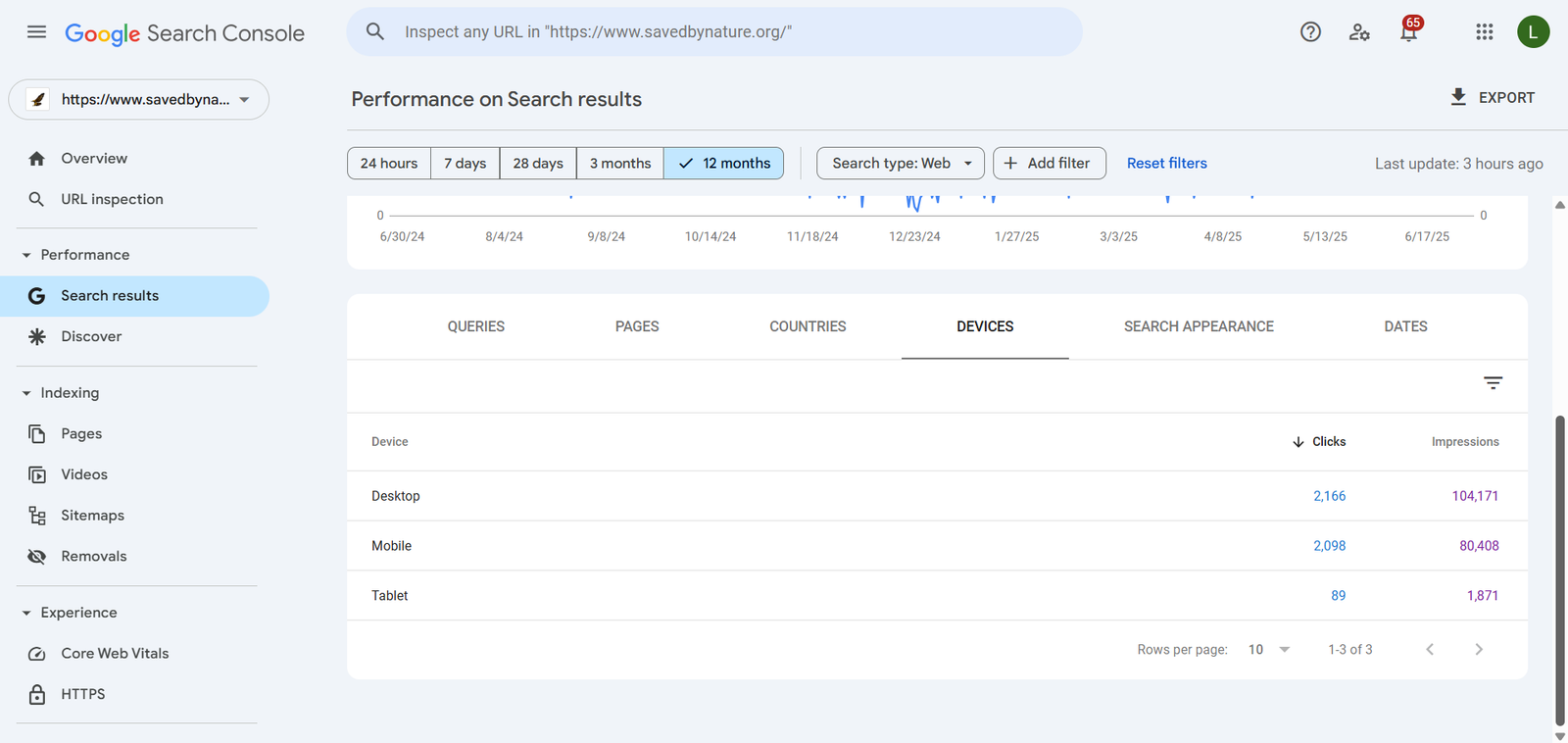
Desktop and mobile were nearly equal in clicks (2,166 vs 2,098), confirming that close to half of all search-driven traffic was arriving on mobile. Combined with the broken mobile navigation documented in the UX audit, this data made mobile optimization a critical priority.
| Device Type | Clicks | Impressions | CTR | Traffic Share | Engagement Quality |
|---|---|---|---|---|---|
| Desktop | 2,166 | 104,171 | 2.11% | 49.8% | 🟡 Standard engagement |
| Mobile | 2,098 | 80,408 | 2.62% | 48.3% | 🟢 Higher engagement rate |
| Tablet | 89 | 1,871 | 4.72% | 2.0% | 🔵 Highest engagement rate |
Mobile CTR (2.62%) exceeded desktop CTR (2.11%) by 24%, with a nearly equal traffic split between the two devices (48.3% mobile vs 49.8% desktop). The data indicated a mobile-first audience behavior pattern — relevant context given the UX findings documented separately, which identified significant mobile usability issues on the original site.
Tablet users demonstrated the highest engagement rate at 4.72% CTR. While the segment was small (2.0% of traffic), the engagement quality was notable — a pattern consistent with the senior demographic, who tend to favor larger-screen mobile devices.
Search presence was consistent across all three device types, with no device entirely absent from the ranking data. Mobile users showed higher intent-to-click ratios despite desktop maintaining a slight traffic volume advantage overall.
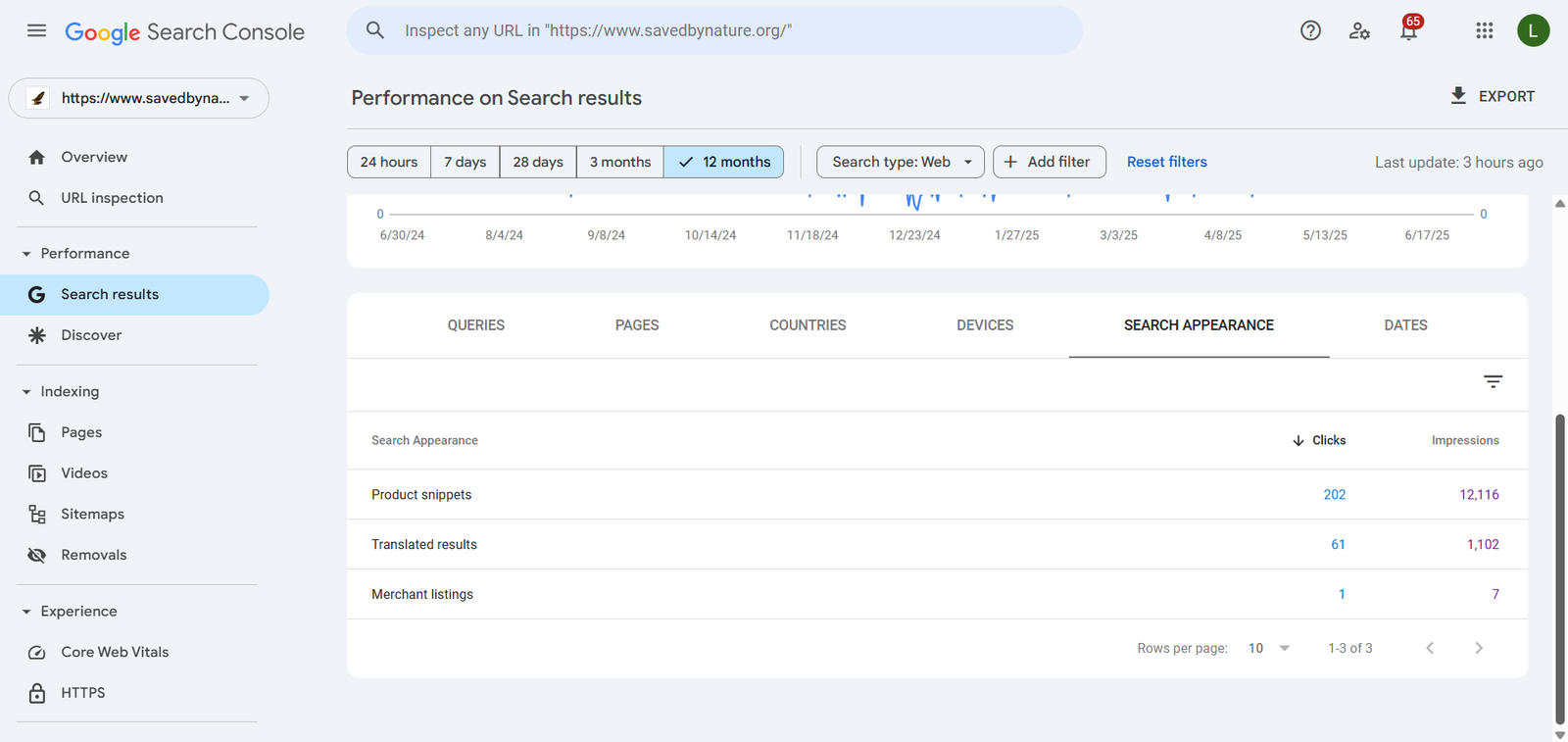
The site was appearing in product snippets (202 clicks) and translated results (61 clicks), but had no presence in rich result types relevant to nonprofit programs — no FAQ rich results, no event rich results, and no structured data driving visibility for its core services. This confirmed that schema markup implementation was a significant missed opportunity.
| Search Appearance Type | Clicks | Impressions | CTR | Assessment |
|---|---|---|---|---|
| Product snippets | 202 | 12,116 | 1.67% | 🟡 Moderate commercial visibility |
| Translated results | 61 | 1,102 | 5.54% | 🟢 High engagement for multilingual content |
| Merchant listings | 1 | 7 | 14.29% | 🔵 Limited but high-converting commercial presence |
The translated results data was one of the more meaningful findings in the entire GSC audit. A 5.54% CTR on 1,102 impressions showed that when Google automatically translated SBN’s content for non-English speakers, those users engaged at a high rate. This was occurring without any native Spanish content on the site — meaning demand existed for multilingual content that SBN had not yet created.
12,116 impressions through product snippets indicated e-commerce content visibility for the Local Birds Pocket Guide. The 1.67% CTR reflected moderate engagement — consistent with the pattern identified in the page analysis, where commercial content had high visibility but relatively poor conversion from search.
Merchant listings appeared only 7 times over 12 months — a data point indicating that structured data for commercial content had not been implemented. The single click that did occur converted at 14.29%, suggesting that where structured data was present, the quality was high.
Brand authority was strong but narrow
SBN had earned genuine name recognition among people already aware of the organization. The 66.74% branded CTR was a legitimate signal of brand health — but it masked the absence of discovery traffic from new audiences.
Educational content was the site’s only consistent organic engine
Freeman Tilden-related content accounted for the majority of non-branded organic traffic. This content served professionals and academics; it did not serve the at-promise youth, BIPOC communities, or multilingual families in SBN’s mission statement.
High-impression content was systematically failing to convert
Multiple pages were ranking in positions 1–5 on high-volume queries and generating CTRs below 1%. This was not a ranking problem — it was a metadata problem. Titles and meta descriptions were not compelling searchers to click.
Five of seven target communities were completely invisible
The mission-community visibility gap was the most significant finding in the audit. An organization that exists to serve underserved communities had built a digital presence that those communities could not find through organic search.
The GSC data also revealed what was absent: no youth intervention or alternative program queries appeared in the dataset; no BIPOC or environmental justice searches were represented; no multilingual (Spanish-language) queries were generating any organic traffic; no queries related to disability-accessible programming, nature therapy, or mental health appeared.
See how it was rebuilt
Full breakdown of the keyword mapping, content rebuild, and GEO optimization that turned invisible search demand into rankings the target communities could actually find.