
$51,831 raised across three months — 69% of an aggressive $75,000 goal, against a list of just 3,001 people. Two channels carried the campaign to a result mass email alone could never have reached. Here’s the full picture, and what it taught me.
Table of Contents
The campaign ran from September 24th through December 31st — three months, two channels, and a goal that required both to work.
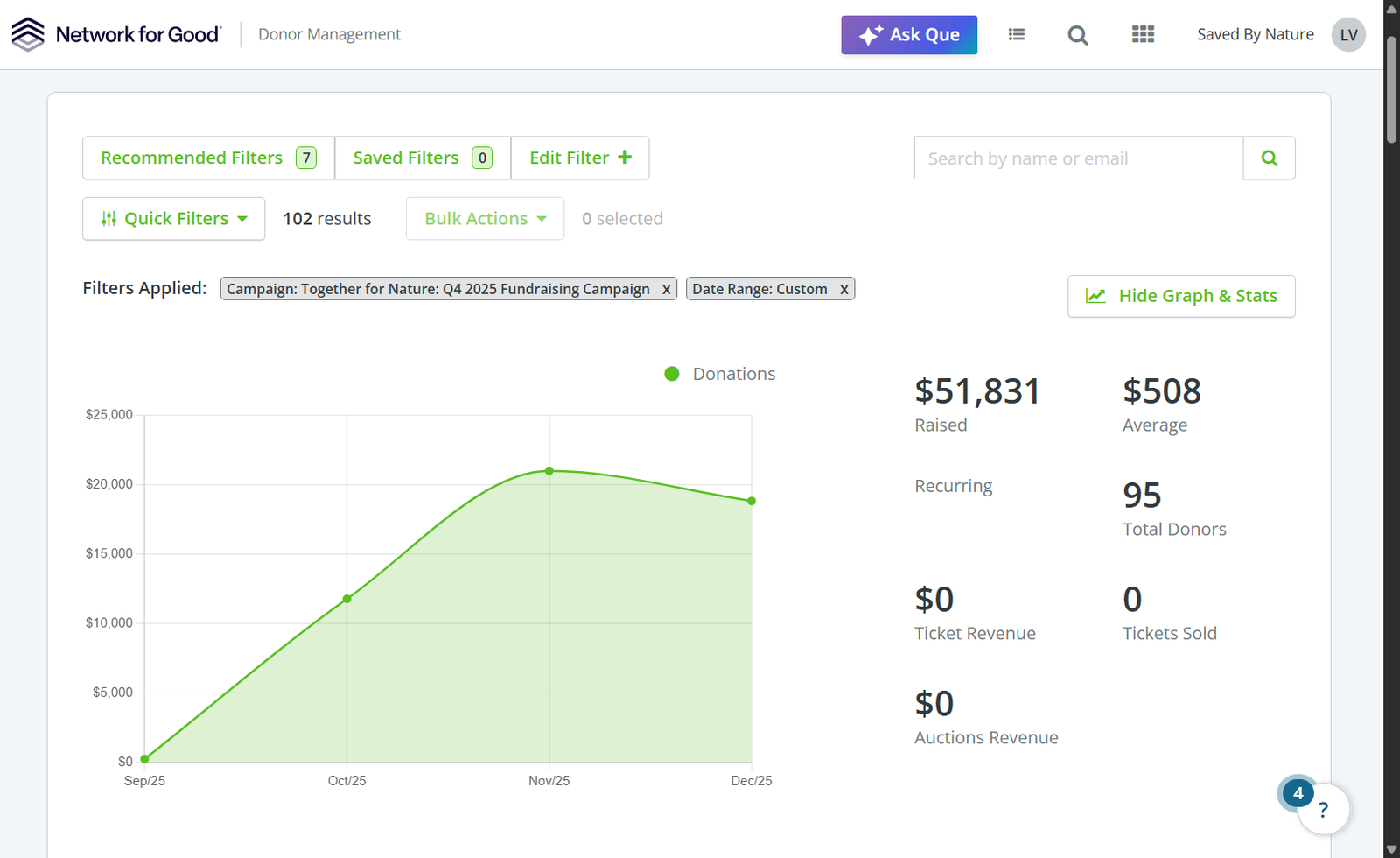
| Phase | Transactions | Amount |
|---|---|---|
| October (Sep 24 – Oct 31) | 66 | $12,000.50 |
| November | 1 | $21,000.00 |
| December | 35 | $18,830.00 |
| Full Campaign | 102 | $51,830.50 |
Gift size tells the same story the channel breakdown does, more simply and with less room for argument about attribution: a small number of large gifts carried the campaign, and a much larger number of small gifts contributed the rest.
of everything raised — $41,300 — came from just 7 gifts of $1,000 or more: the SVCF foundation grant, one individual major gift, the Next Step Fund gift, and four December gifts.
of the total — $10,530.50 — came from the other 95 transactions, every one of them under $1,000.
That’s a steep donor pyramid for a three-month campaign, and it’s the clearest evidence behind the strategic pivot made in November: mass email, on its own, was never going to close a $27,000+ gap. Major donor and foundation relationships did the heavy lifting, while the broader email-reached base — thousands of opens, hundreds of clicks, dozens of gifts — contributed meaningfully but at a fundamentally smaller scale per gift. Both were necessary. Neither was sufficient alone.
A note on what this isn’t
Marketing isn’t about getting it perfect. It’s about testing, gathering insight, and building a better strategy from what the data actually shows — including when it shows less than you’d hoped.
confirmed
October’s Test 1 was the cleanest result of the entire campaign: an urgency/scarcity subject line (“10 Days Left: Don’t Let the $21,000 Match Expire Unused”) outperformed a social-proof subject line (“Join 43 Donors Who’ve Already Doubled Their Impact”) by 7.9% on open rate, with all other variables held identical. That finding was applied to every subsequent send in October and December, including the one subject-line decision December’s entire sequence was built around.
inconclusive
October’s Test 2 compared short and long format and found identical 0.7% click rates between versions — but the two subject lines weren’t worded identically either, so the small open-rate gap that did appear can’t be cleanly attributed to length alone. One test, with a confound, isn’t enough to support a directional claim either way. This needs a cleaner single-variable test in a future campaign before SBN treats email length as a lever worth optimizing.
confirmed
80% of everything raised came from just 7 gifts of $1,000 or more. Mass email, run as well as the data could make it, produced a 2.2% conversion rate in October and never exceeded that — a mathematical ceiling that personal outreach and foundation relationships didn’t share. For a list this size, major donor cultivation isn’t a nice-to-have layered on top of an email program; it’s the primary lever, with email playing a supporting role.
confirmed
September 24th’s deadline error in Version A was a real but minor mistake. The correction email sent 34 minutes later, while well-intentioned, did more damage: Group A’s conversion rate was 0% from 1,314 delivered recipients, against Group B’s $255 raised from a clean send with no correction. Seeing an organization correct itself within the same hour it asked for money was a stronger signal of disorganization than the original error itself. In most cases, a silent fix — correcting the landing page or future emails — costs less donor trust than publicly acknowledging the mistake to the same audience right away.