SBN Website Optimization:
Programs Page Analysis &
Conversion Assessment
Table of Contents
Overview
The Programs section of savedbynature.org had two compounding failures: a near-complete absence of program content, and no infrastructure for the one action these pages exist to enable — enrollment. Every individual program page followed the same pattern. A visitor would arrive, find a schedule and little else, and then have nowhere to go regardless. There was no enrollment form, no registration link, no contact pathway, and no indication of how to actually join. This was both a content problem and a conversion infrastructure problem.
Audit Summary
| Dimension | Severity | Notes |
|---|---|---|
| Photography & Visual Design (desktop) | 🟡 Adequate | Overview card photography strong; individual schedule pages contain no photography |
| Photography & Visual Design (mobile) | 🔴 Poor | Inconsistent card heights and aspect ratios; inconsistent column layout; buttons obscure photos |
| Program Content Quality | 🔴 Critical Gap | Schedules present on some pages; program descriptions, context, and copy absent across all 7 |
| Accessibility Documentation | 🟡 Partial | Per-event ADA notation on Dock of the Bay only; not replicated elsewhere |
| Enrollment Infrastructure | 🟡 Partial | Zero enrollment pathways across all 7 programs; Community Nature Hikes references "signing up" with no sign-up mechanism anywhere on the site |
| Professional Referral Pathways | 🔴 Critical Gap | No mechanisms for healthcare, justice system, or social service referrals on any program page |
| Mobile Experience | 🔴 Poor | Financial CTAs before any program content; inconsistent card layout; buttons covering photos; two program names truncated |
| Technical Stability | 🔴 Poor | Widget Didn't Load errors on multiple program pages; Youth Environmental & Social Justice published on an exposed staging URL |
Programs Overview Page
Hero Section & Inclusivity Statement
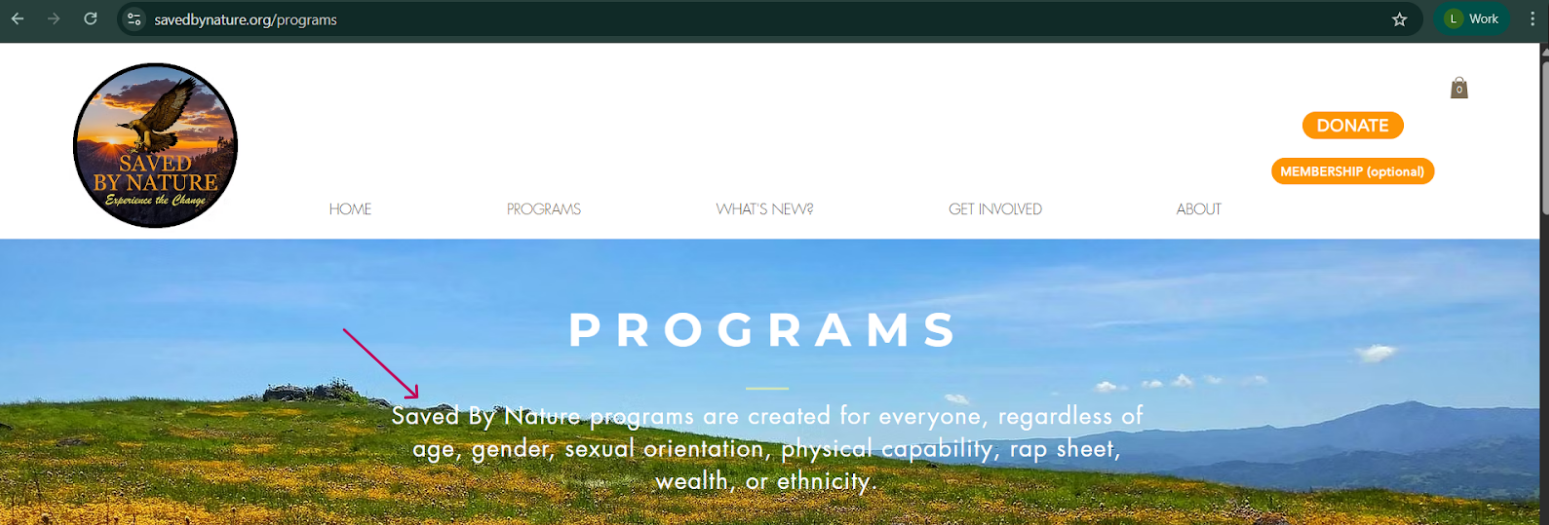
The Programs page opens with a full-width hero image displaying the “PROGRAMS” heading and the following inclusivity statement:
“Saved By Nature programs are created for everyone, regardless of age, gender, sexual orientation, physical capability, rap sheet, wealth, or ethnicity.”
This statement is notable for its specificity. It explicitly names populations that standard nonprofit inclusivity language often omits — people with criminal records (“rap sheet”), people facing economic barriers (“wealth”), and LGBTQ+ individuals. The plain-language approach is appropriate for SBN’s mission and the communities it serves.
The statement sets a clear expectation for new visitors: these programs are designed for people who may have been excluded from traditional outdoor experiences. It communicates values effectively. It is not followed by any pathway to act on that interest.
Program Card Grid (Desktop)
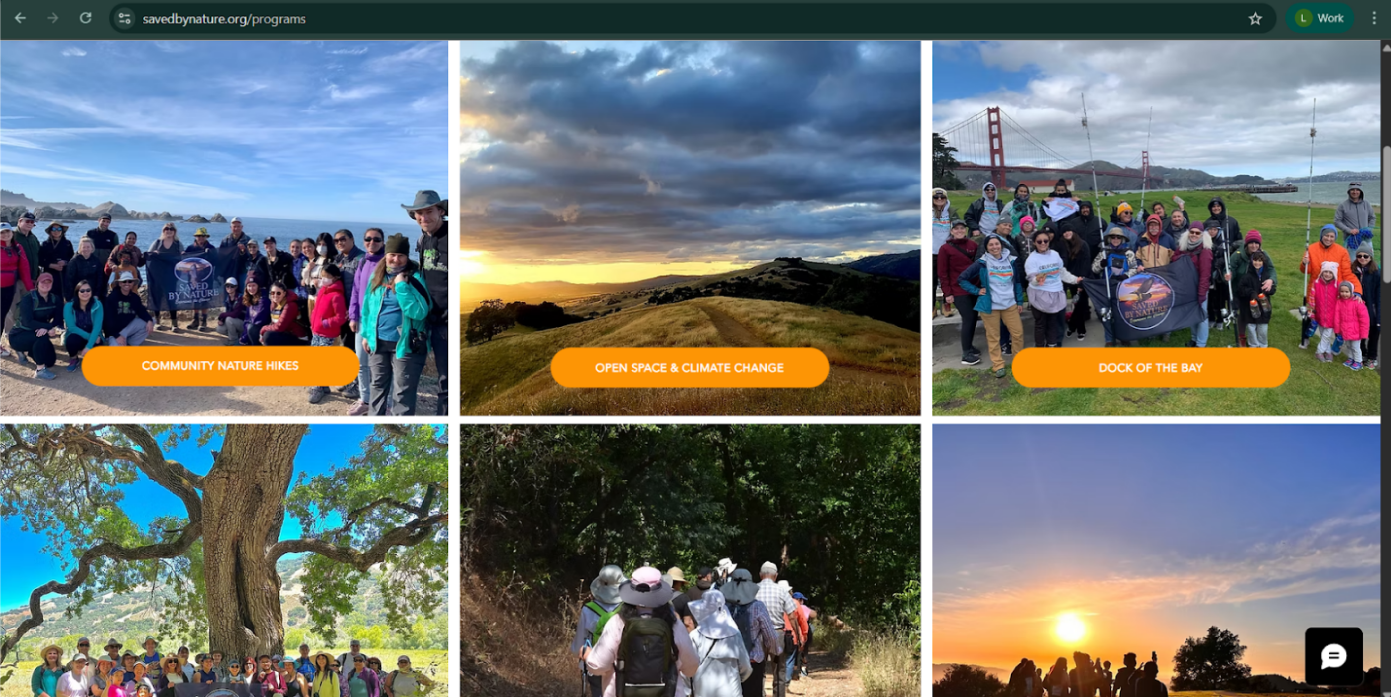
Below the hero, the page presents a six-card grid of program photography. The images are high-quality and feature authentic diversity across age, ethnicity, and ability. Recognizable Bay Area landmarks — including the Golden Gate Bridge area — establish immediate geographic relevance for the target audience.
Each card has a consistent orange button displaying the program name. These buttons are the primary — and only — navigation element on the overview page. Clicking one leads to a schedule page. The photography is strong, but the card grid functions as the entire program discovery layer for the section — and it leads to schedule pages, not program pages. There is no program description, no explanation of who each program is for, no sense of what participation involves, and no pathway to join.
Mobile Experience
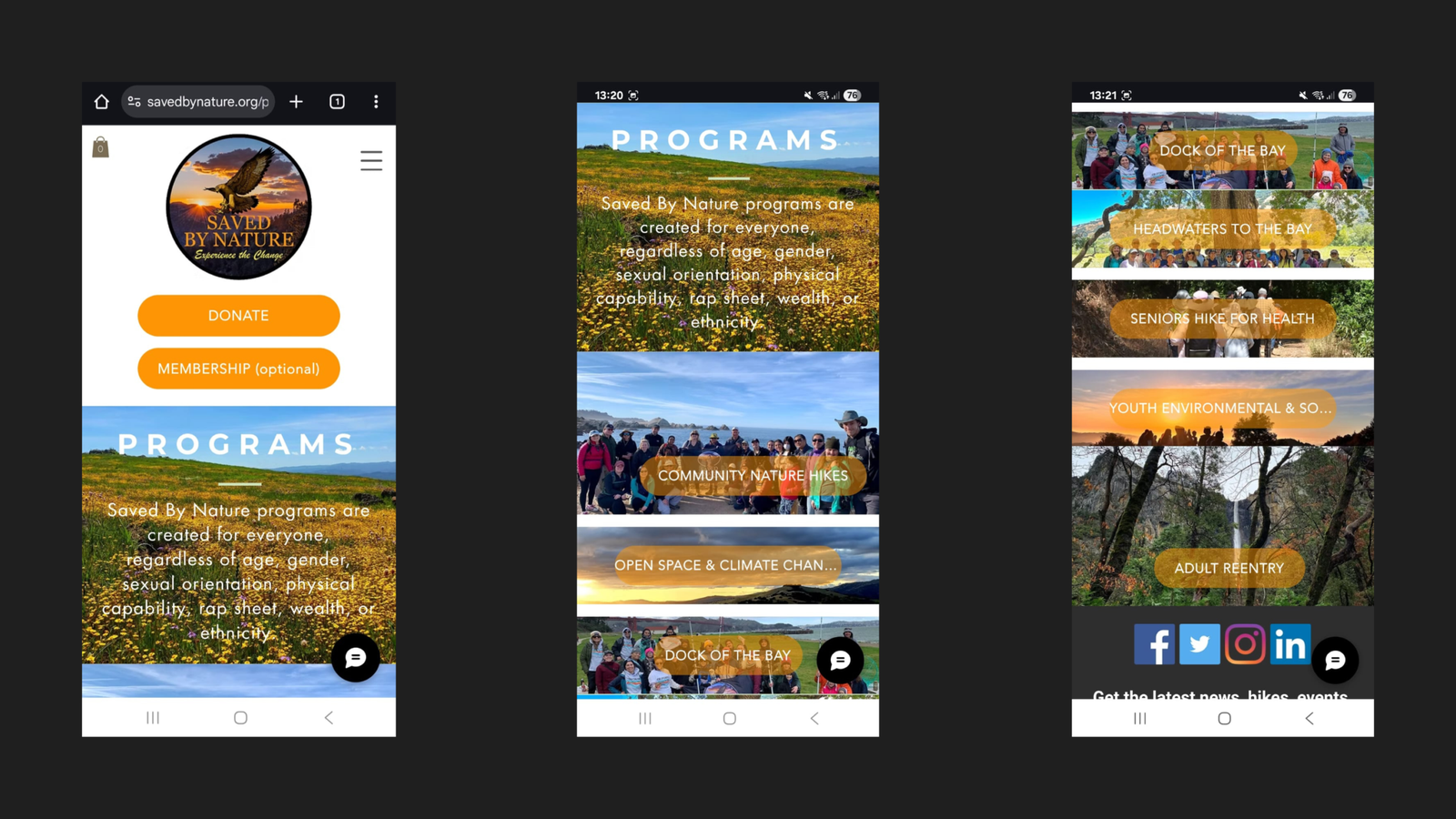
The mobile experience of the Programs page had significant layout failures throughout.
Financial CTAs Before Program Content
The first thing a mobile visitor sees is two full-width stacked orange buttons — DONATE and MEMBERSHIP (optional) — before the hero image, the inclusivity statement, or any program content is visible. The financial ask precedes the entire reason for the page’s existence.
Inconsistent Card Layout
The program cards do not render consistently on mobile. Most cards display full-width in a single-column layout, but Dock of the Bay and Headwaters to the Bay render as a two-column grid — smaller, side-by-side. There is no apparent reason for this inconsistency, and it creates a visually incoherent scroll experience.
Inconsistent Card Heights and Aspect Ratios
Cards vary in height throughout the scroll. Some cards are significantly taller than others, with no pattern that reflects content differences. The layout was not standardized across the card set.
Buttons Covering Photos
The orange program name buttons are semi-transparent, large, and positioned at the center of each card — directly over the photographs. On several cards, particularly “OPEN SPACE & CLIMATE CHAN…” and “YOUTH ENVIRONMENTAL & SO…”, the button covers the majority of the visible image area. The photographs — the primary visual asset of the page — are substantially obscured by the navigation element placed on top of them.
Program Name Truncation
Two program names are cut off mid-word on mobile: “OPEN SPACE & CLIMATE CHAN…” and “YOUTH ENVIRONMENTAL & SO…”. The five remaining program names display in full.
The Adult Reentry Card
Every other program card shows real participants in Bay Area locations. The Adult Reentry card displays a waterfall and forest landscape with no people. The visual inconsistency is immediately apparent while scrolling and signals, before a visitor clicks through, that this program is not in the same state as the others.
No Mobile Enrollment Pathway
The layout failures compound an enrollment infrastructure that does not exist regardless of device. There are no touch-optimized forms, no click-to-call options, and no mobile-specific inquiry mechanisms anywhere in the section.

Individual Program Pages
The Universal Pattern
Every individual program page follows the same structure: a schedule — and in most cases, little else — followed by no enrollment pathway.
| Program Page | Content | Enrollment Infrastructure |
|---|---|---|
| Community Nature Hikes | Schedule + sponsor email only | None |
| Dock of the Bay | Schedule with per-event ADA notation and equipment notes | None |
| Seniors Hike for Health | Founding tribute + donation ask + sponsor email | Sponsorship email only |
| Open Space & Climate Change | Partial schedule | None |
| Youth Environmental & Social Justice | Partner org names + "Learn More" buttons | Partner referral only |
| Headwaters to the Bay | Partial schedule | None |
| Adult Reentry | Placeholder — "coming soon" | None |
The pattern across all seven pages is the same: dates and locations where they exist, and nothing else. No program descriptions. No context about what participation looks like. No information about who each program serves or how it connects to SBN’s mission. And on every page without exception, no enrollment pathway.
Community Nature Hikes
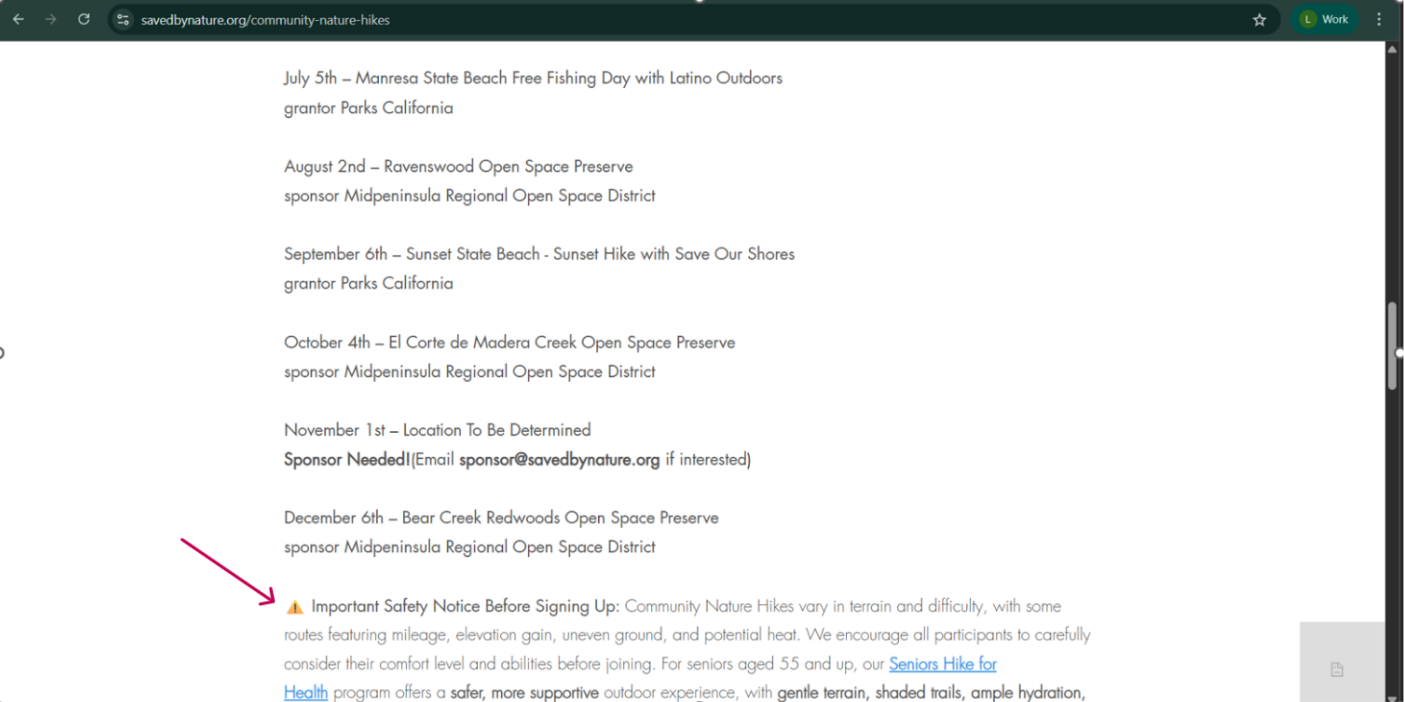
The Community Nature Hikes schedule page lists monthly dates and locations for 2025, with grantor and sponsor organizations credited alongside each entry — Parks California, Midpeninsula Regional Open Space District, Latino Outdoors, and Save Our Shores are all named. The November entry flags that a sponsor is still needed and provides the sponsor email address.
The safety notice at the bottom is headed “Important Safety Notice Before Signing Up” — a heading that presupposes a sign-up mechanism exists. It describes terrain variation across routes and cross-references the Seniors Hike for Health program for older participants. No sign-up mechanism exists anywhere on this page or anywhere else on the site.
This is the page’s complete content. There is no description of what Community Nature Hikes is, who it is for, what a typical hike experience involves, or why someone would want to join. The sponsor email is the only contact address on the page — directed at potential financial partners, not participants.
What is missing: Any program description, enrollment mechanism, or participant contact pathway.
Dock of the Bay
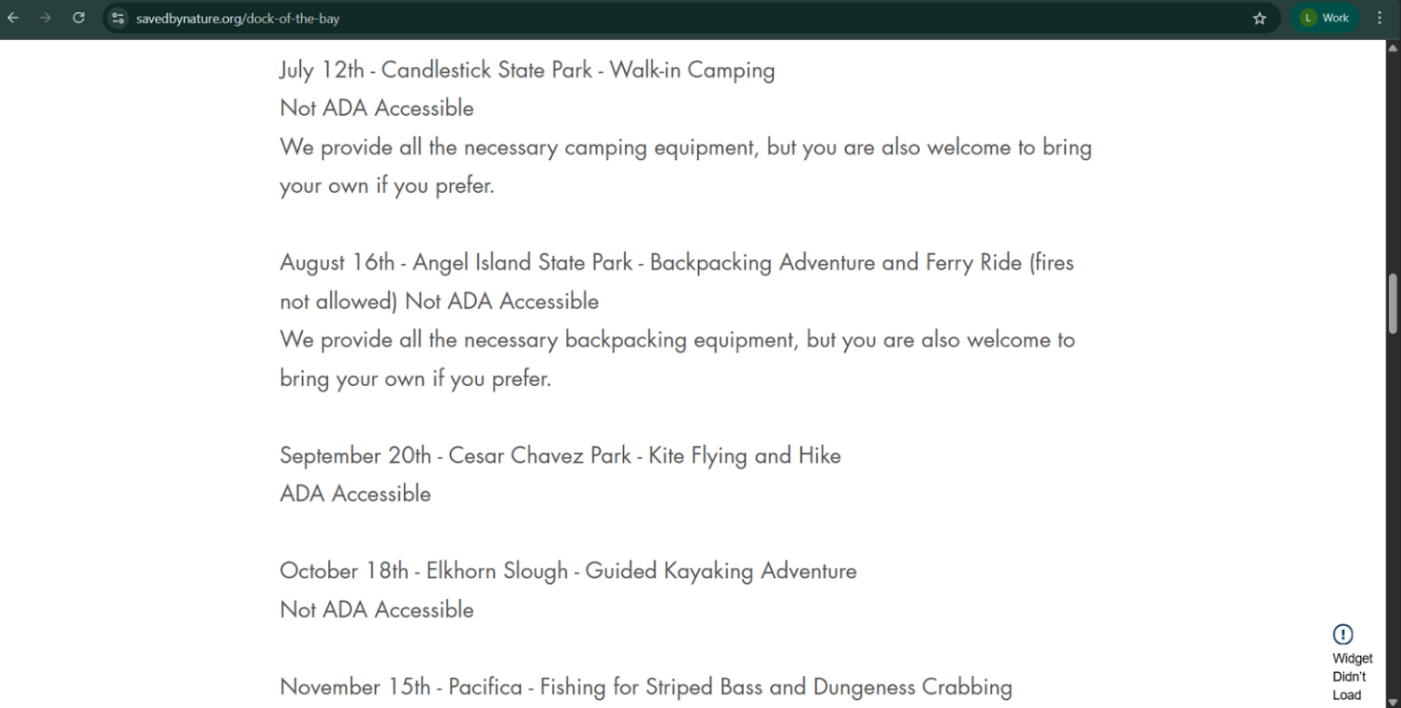
The Dock of the Bay schedule page lists entries across July through November 2025. Each entry includes a date, named location, activity type, ADA accessibility status, and an equipment note — for camping and backpacking entries, the page states that necessary equipment is provided but participants may bring their own. This per-event operational detail is the most specific information on any program page in the section.
Beyond the schedule, the page contains no program description. There is no explanation of what Dock of the Bay is, what the experience involves, who the program is for, or how it connects to SBN’s mission. The activity variety visible in the schedule — walk-in camping, backpacking, ferry travel, kayaking, kite flying, fishing — suggests an active, multi-discipline program. None of that context is communicated on the page.
A Widget Didn’t Load error is visible in the right sidebar, consistent with other program pages.
What is missing: Any program description, enrollment pathway, or participant contact information.
Seniors Hike for Health
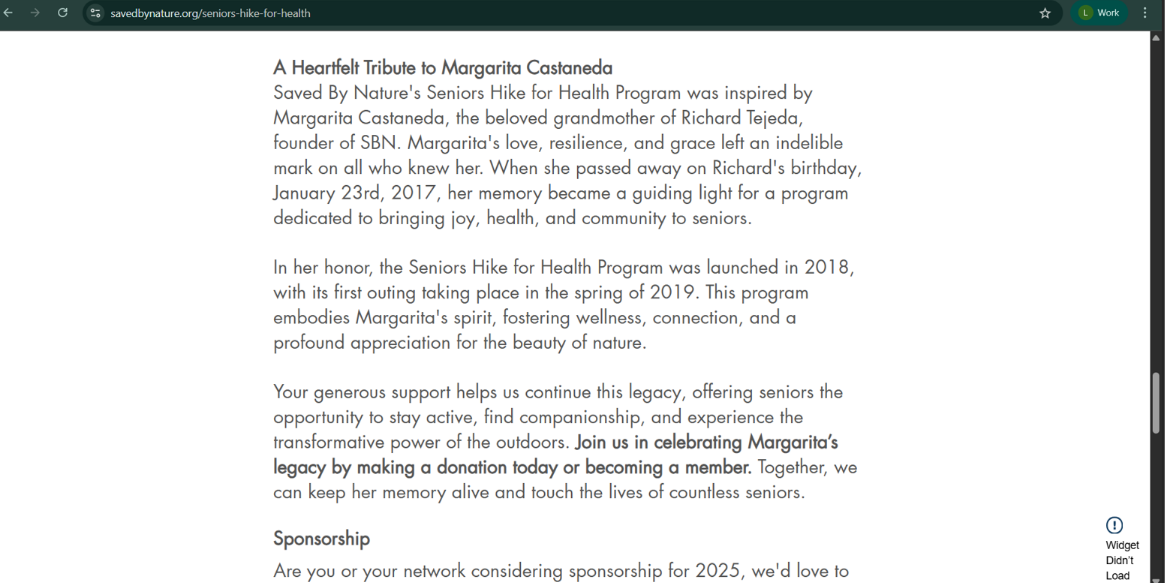
The Seniors Hike for Health page leads with a tribute section headed “A Heartfelt Tribute to Margarita Castaneda.” The tribute names Margarita as the grandmother of Richard Tejeda, founder of SBN, describes her passing on Richard’s birthday — January 23rd, 2017 — and connects her memory to the program’s founding. The Seniors Hike for Health Program launched in 2018, with its first outing in spring 2019.
The tribute section closes with a bolded call-to-action: “Join us in celebrating Margarita’s legacy by making a donation today or becoming a member.” This is the first and only action a visitor is directed toward after reading about the program’s origins. No program description appears before or after it.
Below the tribute, a Sponsorship section invites sponsorship inquiries for 2025. This is the only contact information on the page — directed at financial sponsors, not at the seniors the program is designed to serve.
The page contains no description of what a Seniors Hike involves, where they go, how long they are, what fitness level is appropriate, or how a senior would join. A healthcare provider considering a patient referral would find a founding story and a donation ask with nothing in between.
A Widget Didn’t Load error is visible in the right sidebar.
What is missing: Any program description, schedule, enrollment pathway, or referral mechanism for healthcare providers.
Youth Environmental & Social Justice
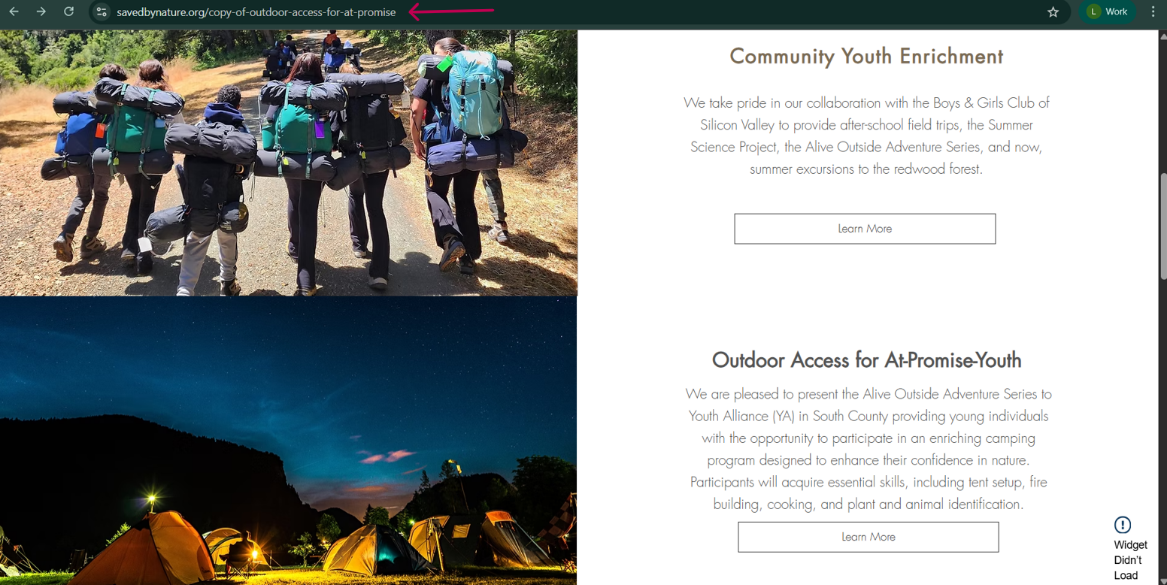
The first thing to note about this page is its URL: savedbynature.org/copy-of-outdoor-access-for-at-promise. This is an exposed staging URL — a draft or duplicate page published without being assigned a clean, descriptive address. Any visitor arriving via this URL, or any search engine indexing it, encounters a page signaling it was never properly finalized.
The page covers two program tracks in a two-column layout. The Community Youth Enrichment section describes after-school field trips, the Summer Science Project, the Alive Outside Adventure Series, and summer excursions to the redwood forest — all delivered in partnership with the Boys & Girls Club of Silicon Valley. The Outdoor Access for At-Promise-Youth section describes the Alive Outside Adventure Series delivered through Youth Alliance (YA) in South County, with participants acquiring camping skills including tent setup, fire building, cooking, and plant and animal identification.
Both sections have Learn More buttons. Widget Didn’t Load errors are visible in the sidebar.
The page names partner organizations and describes program activities, making it marginally more informative than the schedule-only pages. But neither section provides an enrollment pathway. Families cannot enroll directly. The design routes all access through the institutional partners, with no direct community pathway and no mechanism for the probation officers, social workers, and school counselors who would be the most likely referral sources for this population.
What is missing: A clean production URL, a direct enrollment or inquiry pathway for families, and a referral mechanism for justice system and social service professionals.
Adult Reentry
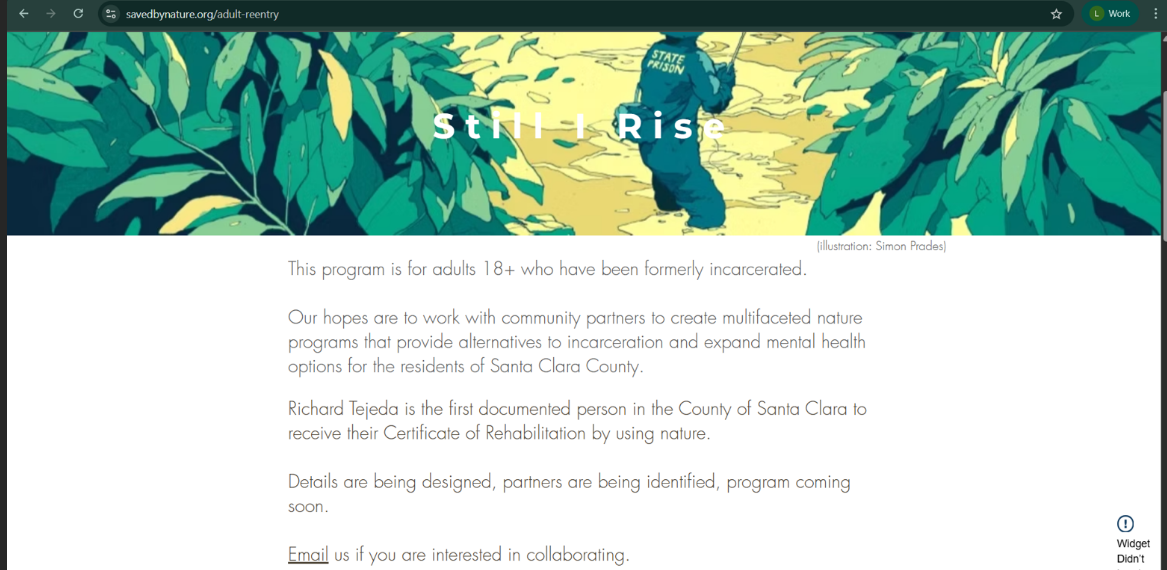
The Adult Reentry page is the most incomplete page in the Programs section. The “Still I Rise” hero illustration is visually striking and tonally appropriate for the program’s target audience — it communicates the emotional register of the program with clarity and intention.
The content beneath it is a placeholder.
The page identifies Richard Tejeda as the first documented person in Santa Clara County to receive a Certificate of Rehabilitation by using nature. This is a significant, original claim — presented in a single line of small body text, not as a headline, not as a prominent feature, and not as a driver of professional referrals from the justice system.
The page closes with two sentences: the program is coming soon, and visitors interested in collaborating can email the organization. “Collaborating” is a partner acquisition frame. It is not a pathway for adults who have been formerly incarcerated and are looking for this specific program.
A Widget Didn’t Load error is visible in the right sidebar.
What is missing: Program content, schedule, enrollment pathway, and any contact method for participants or referring professionals. Given this program’s stated centrality to SBN’s mission, the gap between the illustration’s ambition and the page’s actual content is the most significant missed opportunity in the Programs section.
Site-Wide Conversion Failures
Additional Financial Touchpoints at Page Bottom
Below the newsletter form, the site-wide footer presents two additional items of note.
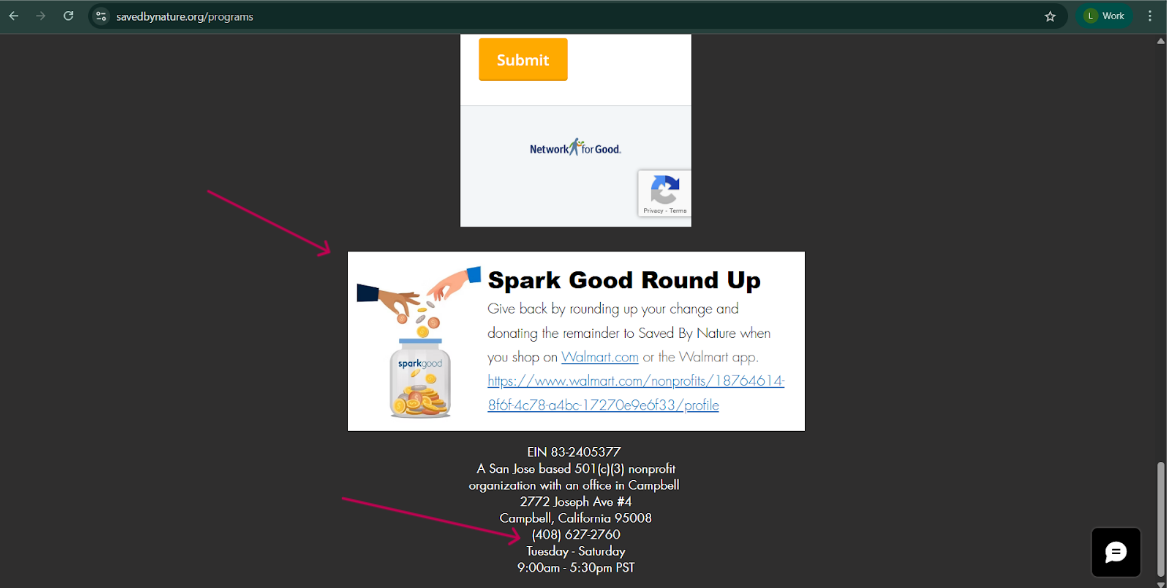
The Spark Good Round Up widget adds a third financial touchpoint — after DONATE in the header and the newsletter form — inviting visitors to round up Walmart purchases in support of SBN. This further extends the site’s pattern of financial infrastructure considerably outpacing participation infrastructure.
The footer also contains the only contact information present anywhere on the site: a physical address (2772 Joseph Ave #4, Campbell, California 95008), a phone number (408-627-2760), and business hours (Tuesday–Saturday, 9:00am–5:30pm PST). These are presented as organizational credentials in the footer, not as a participant contact pathway. A visitor who has read through every program page and wants to ask how to join has no obvious contact mechanism — but if they scroll to the very bottom of the page and read the footer carefully, they will find a phone number.
Professional Referral Pathway Gaps
Several SBN programs are explicitly designed to be accessed through professional referrals — and the site provided nothing for those referrers.
The Seniors Hike for Health page describes clear health benefits that would support healthcare provider referrals. A healthcare provider reading the page would find the emotional founding story, the health benefits, and a sponsorship email. There is no referral form, no professional contact, and no documentation a clinician could use to support a referral.
The Adult Reentry program is designed for formerly incarcerated adults, a population typically reached through justice system professionals. A probation officer looking for reentry programming would find a “coming soon” placeholder — no program timeline, no contact for case managers, and no indication of when the program would be operational.
The Youth Environmental & Social Justice page serves court-involved youth, a population reached through schools, probation officers, and social service organizations. The design routes all access through institutional partners, with no mechanism for the professionals who would initiate the referral.
These are not hypothetical visitors. They are the referral pathways that would drive the highest-quality, most mission-aligned enrollment for SBN’s programs — and the site provided them nothing.
Overall Assessment
The Programs section of the SBN website had two compounding problems: shallow or absent program content across most pages, and no enrollment infrastructure to convert visitors into participants even on the pages where schedules existed. The result was a section of the site that listed programs but provided neither the information nor the pathways needed for community members to join them. Before any conversion infrastructure could be built, the content itself needed to be created.
| Dimension | Assessment | Notes |
|---|---|---|
| Photography & Visual Design (desktop) | 🟡 Adequate | Overview card photography strong; individual schedule pages contain no photography |
| Photography & Visual Design (mobile) | 🔴 Poor | Inconsistent card heights and aspect ratios; inconsistent column layout; buttons obscure photos |
| Program Content Quality | 🔴 Critical Gap | Schedules present on some pages; program descriptions, context, and copy absent across all 7 |
| Accessibility Documentation | 🟡 Present on one program | Per-event ADA notation on Dock of the Bay; not replicated elsewhere |
| Enrollment Infrastructure | 🔴 Critical Gap | Zero enrollment pathways across all 7 programs; safety notice on Community Nature Hikes references signing up with no sign-up mechanism anywhere on the site |
| Professional Referral Pathways | 🔴 Critical Gap | No mechanisms for healthcare, justice system, or social service referrals on any program page |
| Mobile Experience | 🔴 Poor | Financial CTAs before any program content; inconsistent card layout; buttons covering photos; two program names truncated |
| Technical Stability | 🔴 Poor | Widget Didn't Load errors on multiple program pages; Youth Environmental & Social Justice published on an exposed staging URL |
This audit reflects the observed state of savedbynature.org/programs and all individual program pages as of July 2025. All findings are grounded in visual and structural review of the website at the time and are documented in page screenshots.